Back in May of 2013 I did a post called
Remembering IGPX, which was a collection of thoughts about a TV show I watched years ago. I am thinking I might try to make something of an irregular series of that sort of post, and the series would be called “Remembering.” These posts are not intended to be in-depth reviews or analysis of shows that I watched when I was younger, though you will find bits of both in them. Rather, I hope the discussions that follow to mimic what it would be like for us to be sitting down together and me recounting to you the show, as I remember it. When we remember things in the past we don’t always remember everything in chronological order, level or importance, or exact detail, so I won’t cover every facet of the show, but just what stood out to me. Also, I am going to try to write these posts with a minimum usage of the internet for reference material, other than images to use for the posts. Consequently, there may be a few factual errors and I apologize in advance if I get anything wrong. If I’m not entirely sure on something I will try to clearly state so. Theses posts will also contain spoilers for whatever show is being discussed, so consider yourself warned.
-----
I had seen some anime during my junior high and high school days, but it was in college that I started watching a wider array of anime TV shows, and television in general. Granted, it was still a modest number of shows and I could never claim to be an anime geek, but compared to up to that point it felt like a broad new horizon. One of the animes that I watched in college was a show called Big O, which ran for two seasons.
 |
| Paradigm City |
Big O takes place in Paradigm City; a city with funny name but an interesting premise. Forty years ago something happened but no one knows what it was and no one has any complete memories of anything that happened prior to forty years ago. Whatever happened was clearly catastrophic, as there seems to be almost no known human civilization beyond the greater area around the city. There are hints of foreigners beyond the wasteland, but it is not until the end of the first season of the show that you get a definitive answer. The metropolis of Paradigm City is itself split into two worlds. The affluent and well connected live within the massive domes that cover a good chunk of the city, while everyone else lives in the urban sprawl that makes up the rest of the city. Interestingly enough, although it is called Paradigm City, there are a number of times where the city is shown from an aerial view and it is clear from those shots that Paradigm City is in fact New York City. There’s even one time in the show where the river next to the city is called the Hudson. No mention is ever made about the city having a different name in the past, so you just have to assume that it’s always been that way for the sake of the story.

Residing within Paradigm City is the show’s cast, led by protagonist Roger Smith. Roger is a professional negotiator who holds substantial wealth and lives in his own private tower, albeit outside the domes. What sets Roger apart from most other people in Paradigm City, however, is that he (secretly) pilots a massive robot called Big O, and now you know where the title of the show comes from. Roger is also unique in that he occasionally experiences flashbacks to Paradigm City prior to forty years ago, indicating that he possesses memory fragments from that time. This is puzzling because Roger is less than forty years old, and I don’t remember if the show’s finale gave a clear explanation or not for how Roger has his memories.

Playing second fiddle to Roger is R. Dorothy Wayneright, referred to simply as Dorothy, a female android. I guess androids are technically gender neutral, but Dorothy has a feminine figure and voice, and something of a feminine personality. Like Roger, she possesses (within her hard drive) memories from prior to forty years ago, though this is not known until later in the show. Dorothy becomes something of Roger’s assistant at the start of Season One after Roger takes on a case involving the man who built Dorothy, and their relationship develops into one of Dorothy sometimes annoying Roger, sometimes providing bits of comic relief, and sometimes saving Roger’s life. The interplay between Roger and Dorothy is one of several relationships between humans and androids that the show explores.

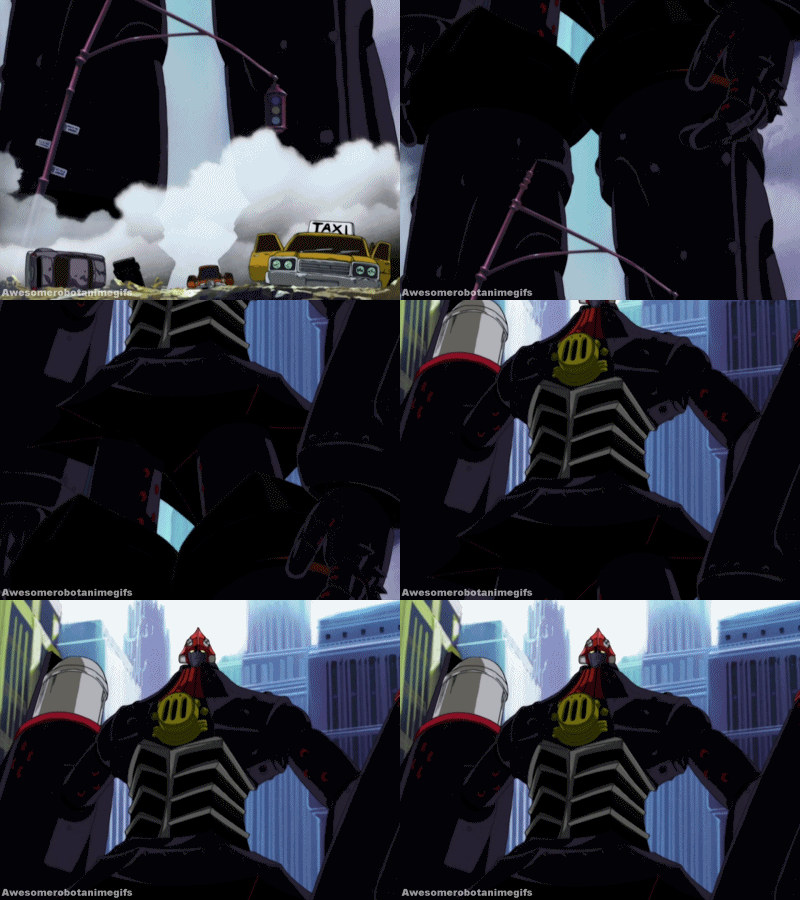
Rounding out the trio of characters that I’ll discuss in any depth is the titular Big O itself. A giant robot in the Big O universe is generally referred to as a “megadeus,” however a small number of giant robots are distinguished from the others by being called a “big.” Roger’s megadues is one such robot and holds the name Big O. When I watched the Big O series, I noted how different Big O’s design was from other anime robots at the time. Big O is neither sleek nor fast, and is lacking many of the “cool” factors of most robots in anime, such as wings, energy swords, and infinite ammunition. Instead of looking futuristic, Big O looks like robot designed during an earlier age with stovepipe limbs and giant rivets/screws throughout its exterior. Its primary means of attack are its seemingly indestructible fists, which are augmented by massive pile drivers that are built directly into its arms. Big O moves around Paradigm City using the city’s abandoned underground subway network, and comes bursting out of the ground at Roger’s command, ready to do battle.
 |
| Who chose who? |
You might be wondering why I chose Big O as a character to discuss in the last paragraph. Normally giant robots are just instruments of the people who pilot them, but in this case I think it’s fitting to call Big O a character because it, and all the other megadeuses of the show, is a actually semi-sentient machine. Although Big O does not talk or interact with the other characters in the way a person normally would, Big O is clearly alive in some way. It can move on its own without Roger and at a number of times demonstrates independent thought. Actions like these by Big O and other megadueses lead Schwarzwald, one of the show’s villains, to question whether or not megadeuses even need pilots and if it is really the megadeuses that choose their pilots and not the other way around. In the second season of the show there is an episode where a megadeus actually rejects and kills its pilot. Just how sentient the megadeuses are is unclear, but they more than mere unthinking machines.
 |
| Roger's version of the Batmobile |
Now, I would be grossly negligent if I failed to mention that there are a number of notable similarities between the Big O series and the Batman series. Both star a wealth guy with an alter ego that defends their respective cities. Both Roger Smith and Bruce Wayne have a faithful butler who is mysteriously just as skilled in combat as in cooking. Both Roger and Bruce drive a large, black, heavily armed car. Both Roger and Bruce are connected to the local police chief. Both Roger and Bruce have an on-and-off romantic relationship with a sometimes friendly, sometimes antagonistic female who has a habit of wearing form-fitting outfits. Both shows even have a white-faced sadistic villain who revels in inflicting pain and chaos. From what I understand, the studio that made Big O also worked on the Batman animated series from the 1990s, which would go a long way to explaining the similarities. I wouldn't go so far as to say Big O ripped off Batman, but the parallels are striking indeed.
 |
| There goes another building |
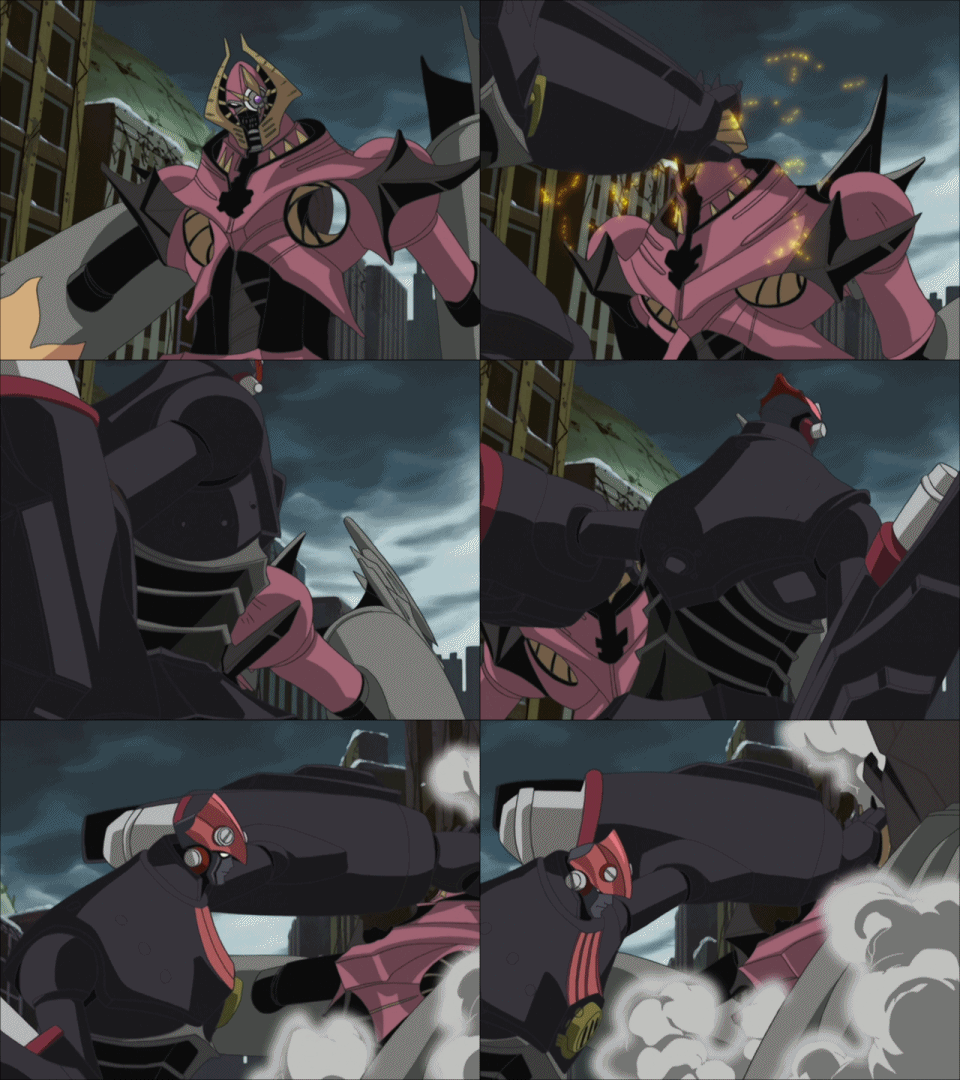
For a hero, Roger has a strange disregard for collateral damage. Though not all of Big O’s battles take place within Paradigm City, when they do you can make a safe bet that multiple buildings are about to get destroyed. Dan Datsun, the man with the unenviable job of leading the Paradigm City police force, laments this fact from the very first episode, where Big O throws another giant robot into a nearby building. I can only imagine that construction is the biggest industry in Paradigm City, rebuilding the structures damaged or destroyed whenever giant robots do battle and paving over the massive sinkholes created by Big O emerging out of the ground. On top of this would be the necessary human casualties from every engagement. If we were to try to do an honest estimate, I would suspect that Roger and his megadeus are directly or indirectly responsible for hundreds of billions of dollars of property damage and a few thousand deaths. But Roger is the hero, and Big O is not exactly a realistic show, so let’s not dwell too much on these things.
 |
| Venetian blinds - a noir classic |
Being an older anime, Big O can look a little rough compared to some of its modern counterparts, but it did have a distinctive film noir look, primarily in the first season. The show made frequent use of low-key lighting and the disorienting camera angles, much like old film noir movies. Roger himself is something of a noir archetype; a disillusioned former cop haunted by the past. This noir style was scaled back somewhat with the animation changes in Season Two, but it is still noticeable. The animation of Season Two was a bit cleaner and crisper, but the animation from Season One was more distinctive.
 |
| Big O squares off with Big Fau |
It’s fitting to wrap up this memory exercise with how Big O concluded at the end of Season Two. Big O is one of those shows with an ending that befuddled some, disappointed others, and led a number of people to seriously analyze it to try to figure out exactly what happened. As Roger battles it out with the show’s ultimate villain, it appears the apocalypse of forty years ago is about to be repeated. In a crazy twist, it turns out everything that Roger and everyone else has been doing is part of a show. This had been suggested at a number of times during the series, and the confirmation meant all the characters were just actors who had no idea what the script was or who was directing everything. There are even massive stage lights high above the city, though they had never been visible due to Paradigm City’s perpetual cloud cover. The “director” appears in the form of a megadeus and begins erasing everything, and Roger makes a last ditch effort to negotiate with the director. In a TV control room, a separate Roger, Dorothy, and the director (in human form) are watching themselves play out the scene on the monitor. The director and Big O (with Roger and Dorothy inside) walk into each other and in a flash of light the show returns to where it began in episode one.
So, what exactly happened? I’m not one of those people who seriously analyzed the ending so I can’t give you a definitive answer. My best guess is that Roger managed to talk the director out of completely erasing the world, and even though it appears that the world was reset back to what it was in the first episode, there are a few small differences so it must not have been a complete reset. Maybe Roger is now the “director” and will change the fate of Paradigm City. I don’t know. Big O’s ending is one of those ones those divisive ones. Personally, I’m ok with ambiguous endings so it didn’t bother me too much. I think I remember reading somewhere that Big O was intended to have a third season but it was cancelled and so the writers had to pack everything into the last few episodes of Season Two. Whether this is true or not, I do not know, so I consider this a questionable explanation for the ambiguity of Big O’s ending.
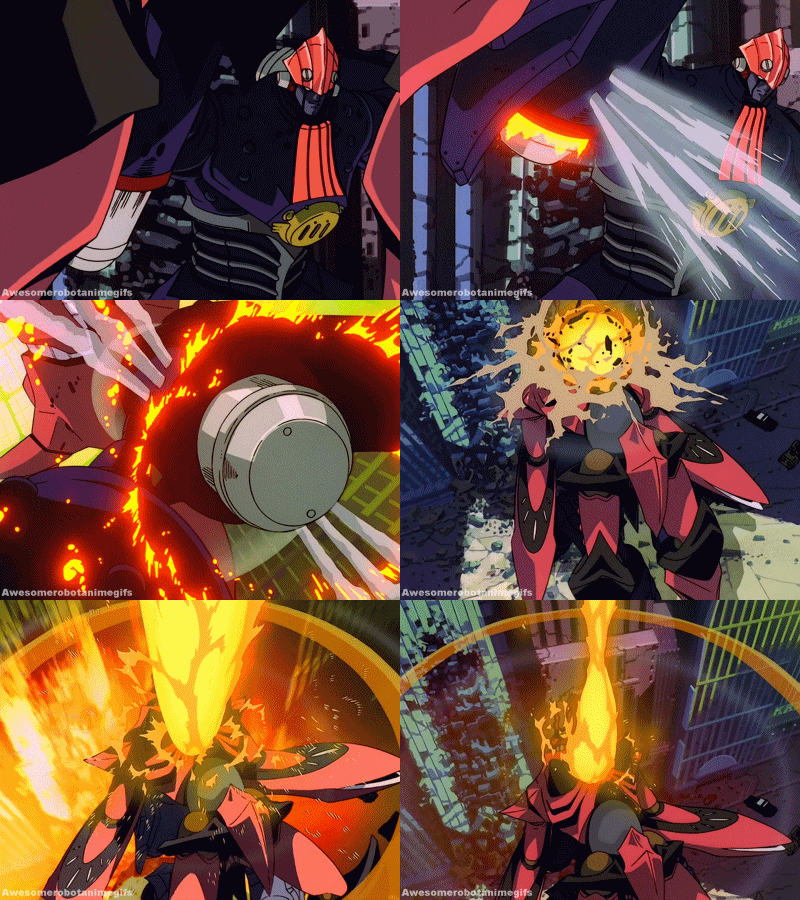
And that’s how I remember Big O. It wasn’t the best anime, but it was an interesting one, and I think it’s fitting for this first (well, actually second) post in this series about remembering to be about a show where memories play an important part of the story. It also had plenty of moments like the gif on the right. Giant robots fighting each other never gets old.